Don’t Just Buy a Trailer…Invest in Long-Term Performance
Choosing the right dry van trailer is one of the most important business decisions a fleet manager can make. The trailer you invest in today will affect your operational efficiency, maintenance costs, and bottom-line profitability for years to come. In a market where budgets are tight and industry demands are evolving, many buyers will default to saving money upfront without considering the long-term implications or total cost of ownership of the trailer.
To help you make a smarter, lifecycle-based trailer purchasing decision, let’s take a look at two popular types of trailer construction on the market: traditional sheet-and-post trailers (S&P) and
Wabash’s DuraPlate® composite panel technology.
Drawing from real-world performance data and analysis, we’ll explore how structural integrity, damage resistance, weight efficiency, and extended service life affect trailer uptime and long-term profitability. While S&P trailers may offer a lower initial purchase price, DuraPlate technology delivers substantial advantages that translate into measurable improvements in total cost of ownership and revenue-generating potential throughout the life of the trailer.
By the end, you will have a clear understanding of how the right trailer can deliver measurable savings and better fleet performance and why forward-thinking fleet managers prioritize total value over initial cost.
Dry Van Construction Basics
First, let’s start with the basics of how each trailer is built.
S&P trailer construction follows the conventional method of manufacturing a dry van. Inside the trailer, aluminum posts are positioned at regular intervals to form the structural framework. Thin aluminum sheets attach to those posts to form the exterior walls. The interior can be lined with plywood or plastic for added protection.
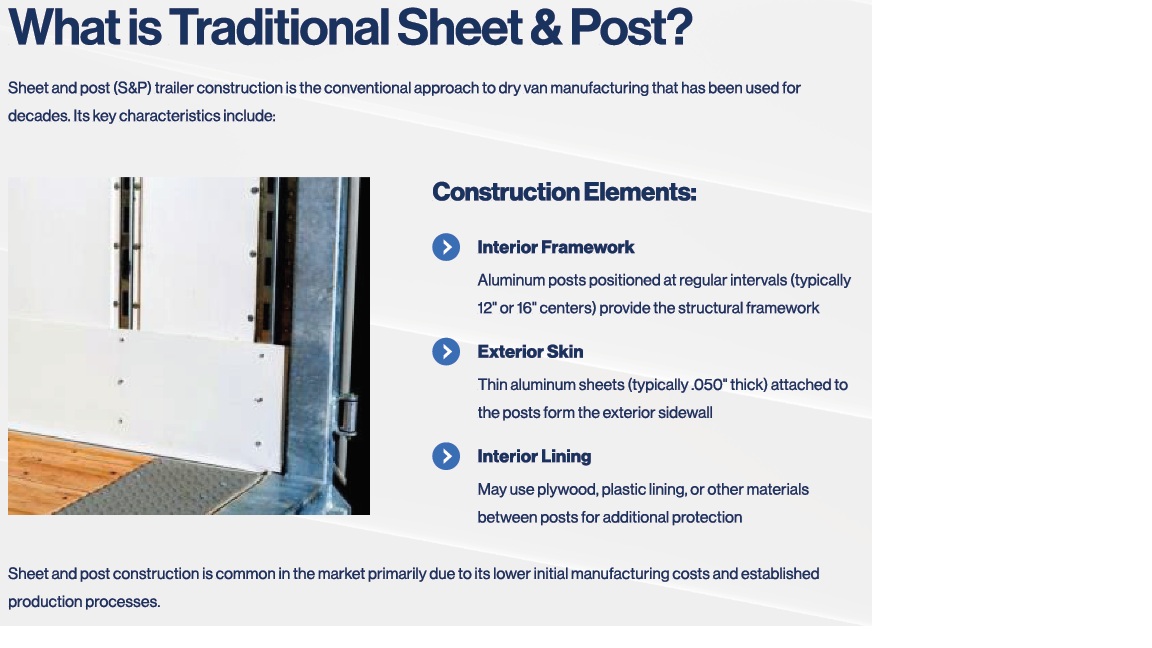 S&P trailers are the most common in the market. Because S&P trailers are simpler in design, they cost less to manufacture and therefore carry a lower initial purchase price. But their low-cost construction means they’re more prone to damage and water intrusion over time, which add to maintenance costs and impact customers total cost of ownership over the life of the trailer.
Wabash DuraPlate takes a different approach. Since its introduction in 1996, its proprietary composite panel technology has revolutionized dry van trailer construction. DuraPlate trailers have a high-density polyethylene (HDPE) core that gives them their structural strength while remaining lightweight. Pre-coated, galvanized steel skins made of 80,000 psi-yield strength laminated to both sides of the core. The composite panel itself serves as both the skin and structural element for strength and protection in a lighter design.
To meet different fleet needs, Wabash offers two DuraPlate variations: Cell Core and HD. DuraPlate Cell Core uses engineered cellular structures to reduce a trailer’s weight by up to 300 pounds without sacrificing strength or durability. DuraPlate HD features reinforced lower sidewalls with a 22″ aluminum baseplate for added protection in heavy-duty, high-impact applications.
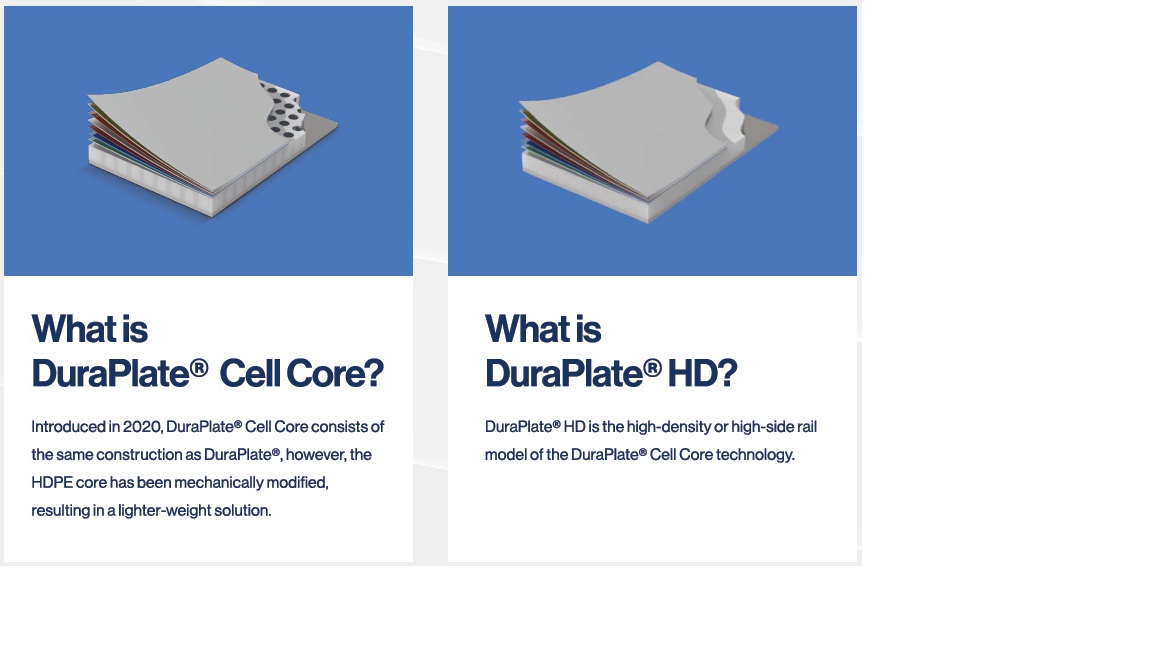
Wabash’s revolutionary approach to trailer construction fundamentally changes a trailer’s structural dynamics, damage resistance, and lifecycle performance—differences that directly impact fleet performance, operational metrics, and total cost of ownership.
Head-to-head comparison: DuraPlate vs. S&P
Impact resistance: DuraPlate proved to be 5–7x stronger in puncture tests for extreme durability
DuraPlate trailers are designed to withstand physical damage much more effectively than S&P trailers. DuraPlate trailer technology has 5-7x the puncture resistance of S&P trailers, for extreme durability and impact resistance.
To prove it, we tested the puncture resistance of the trailer walls with two tests: a ½ Ball Test, representative of a concentrated impact, and a 6” Spade Test, representative of a forklift tine.

In the ½ Ball Test, which simulated a sharp, localized hit, DuraPlate resisted 2,100 pounds, and Cell Core resisted 1,300 pounds. The sturdiest S&P aluminum skin resisted only 500 pounds. In the Spade Test, which simulated repeated hits like a forklift striking the trailer wall, DuraPlate resisted 7,700 pounds, and Cell Core resisted 5,200 pounds. The sturdiest S&P aluminum skin only resisted 1,500 pounds.
DuraPlate can withstand up to 7 times more force than S&P trailer construction, meaning they’re far more durable against everyday impact from loading, forklifts, and accidents.
Structural performance: DuraPlate trailers have a 5- to 7-year longer service life
DuraPlate trailers outperform traditional S&P trailers across every key structural category. Their structural differences directly impact trailer longevity, maintenance requirements, and overall lifecycle performance.
Unlike S&P sidewalls, which can flex only a few inches before the posts permanently buckle, DuraPlate panels can flex up to 12 inches during operation and return to their original shape, to maintain integrity under stress. Their construction offers superior water protection: the header and top rail overlap the wall panels to reduce the opportunity for leaks, while full-length corner posts ensure no water intrusion. In terms of material durability, DuraPlate panels resist rot and delamination (separating or peeling apart) over time, whereas S&P walls are more prone to deterioration.
The enhanced structural integrity of DuraPlate trailers delivers a five- to seven-year longer service life than traditional S&P designs.
Weight comparison: DuraPlate Cell Core weighs up to 800 pounds less
DuraPlate Cell Core technology delivers a significant weight advantage over S&P trailers. An S&P trailer built with plywood sidewalls weighs 13,510 pounds; one with HDPE construction weighs 13,855 pounds.
DuraPlate trailers weigh less. DuraPlate HD Cell Core trailers weigh 12,995 pounds; DuraPlate Cell Core is lighter at 12,941 pounds. This means DuraPlate Cell Core can be up to 800 pounds lighter than comparable S&P trailers, helping fleets improve fuel efficiency and lower their total operating costs while also increasing payload capacity to boost revenue.
Repair costs: DuraPlate costs around $548 less per repair and ~44% less labor for a faster turnaround and less downtime
When a repair is needed, DuraPlate trailers are significantly less expensive to fix than S&P models. According to the 2021 NTDA Labor Hours Guide and industry standards for labor and S&P costs, repairing an S&P trailer, which requires removing and replacing one sheet R&R and three posts, costs $2,732, including $1,377 in labor, $105 in parts, and $1,250 in towing.
Repairing a DuraPlate composite panel costs $2,184 total: $769 in labor, $165 in parts, and the same $1,250 tow cost. That’s a savings of $548 per panel repaired, thanks to DuraPlate’s simpler, more efficient repair process. As you’ll read in the next section, S&P trailers typically need more frequent repairs, which means you’re paying more money, more often.
Maintenance profile: DuraPlate’s better design improves serviceability and reduces repairs for increased uptime
DuraPlate trailers are engineered for easier maintenance and a longer service life compared to S&P trailers. S&P trailers often require more frequent repairs from routine wear and tear, whereas DuraPlate trailers typically only need maintenance after an accident or collision. DuraPlate design focuses on features like drip gutters, full-length corner posts, and embedded marker lights that make repairs faster and simpler for improved serviceability.
Over time, DuraPlate trailers see fewer maintenance issues and maintain a longer floor life, helping fleets reduce downtime. With their thoughtful design features and fewer repair needs, DuraPlate trailers deliver greater uptime and lower maintenance costs throughout their lifetime, compared to conventional S&P construction.
Value retention and longevity: DuraPlate trailers have a higher resale value despite lasting up to 4 years longer
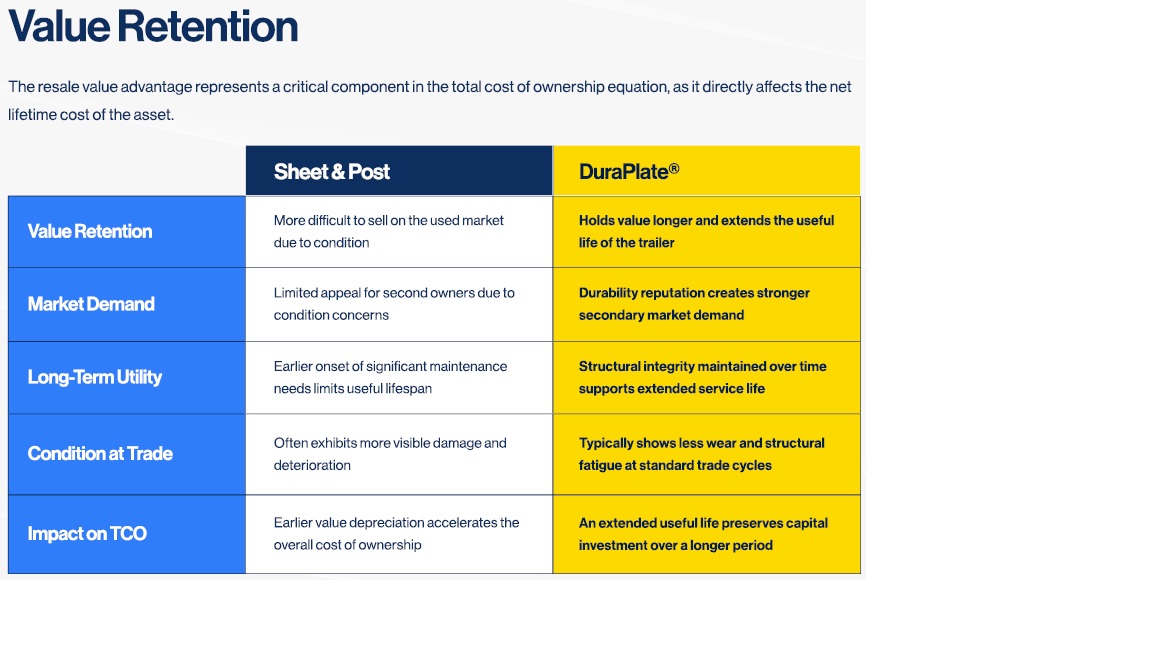
DuraPlate trailers hold their value longer and also live a longer service life than traditional S&P trailers. The result? A lower cost of ownership throughout a trailer’s lifetime. The durability of a DuraPlate trailer helps maintain its structural integrity better over time, boosting both its resale value and secondary market demand.
Where S&P trailers typically show more wear and lose value quickly, DuraPlate trailers retain their value condition and market appeal, allowing owners to recover more of their investment when they go to trade in. This long-lasting durability also extends the typical life of a DuraPlate® trailer to 10 to 12 years, compared to only six to eight years for S&P trailers.
As you evaluate your trailer options, remember that the most significant long-term cost factor isn’t going to be on your initial purchase receipt. It’s going to be in the number of trailers you’ll purchase over time. Ultimately, investing in DuraPlate means investing in 33% fewer trailer purchases over 20 years.
Decision time: When to choose DuraPlate vs. S&P
Do you choose a DuraPlate trailer or an S&P trailer? While DuraPlate delivers significant advantages for most fleets, the choice really comes down to your operation’s needs.
Choose a DuraPlate trailer when:
- Total cost of ownership matters more than the initial price. Its five to seven years longer service life delivers significant operational savings over time that outweigh the initial cost.
- Maximum payload matters. With more than 800 pounds of weight savings, DuraPlate increases payload capacity and revenue potential.
- You experience frequent impact damage from everyday activity. DuraPlate’s 5-7x greater puncture resistance protects against your daily operations.
- Reducing repair time and costs is important. DuraPlate repairs require approximately 44% less labor time, for $548 less in repair per incident and faster return to service.
- You value stronger resale positioning. DuraPlate trailers hold their value longer in the secondary market due to better condition retention and structural integrity.
There’s only one instance in which a DuraPlate trailer may not be your best option: When your initial capital is extremely limited, constraining your ability to make the upfront investment despite higher lifetime costs. While S&P trailers cost less upfront, they typically incur higher maintenance costs, a shorter service life, and lower resale value over time.
The takeaway for fleet managers: Total lifecycle performance is essential for maximizing return on equipment investments
Trailer selection shapes profitability and operational efficiency. As freight demands evolve and operational margins remain under pressure, the long-term economics of trailer selection are more critical than ever. Forward-thinking fleet managers recognize that the true cost of a trailer extends far beyond its sticker price. Evaluating total lifecycle performance, including durability, repair frequency, weight efficiency, and resale value, is essential for maximizing return on equipment investments.
DuraPlate: A stronger, lighter, longer-lasting investment
Forward-thinking fleet managers think long term, not just about the initial purchase. DuraPlate trailers deliver a proven combination of strength, damage resistance, and longevity that translates into lower total cost of ownership and improved bottom-line performance.
For most fleets, DuraPlate is a stronger, lighter, longer-lasting investment that pays for itself over time.
Learn more about how DuraPlate® can impact your fleet’s bottom line here.